A breaker that trips for no clear reason makes most people uneasy. You flip it back on. The lights return. But you still wonder what just happened. If it was an AFCI breaker, it may have reacted to a specific hazard, not a plain overload. Homeowners often meet these breakers during panel upgrades and remodels.
What Is an AFCI Breaker and What Does It Do?
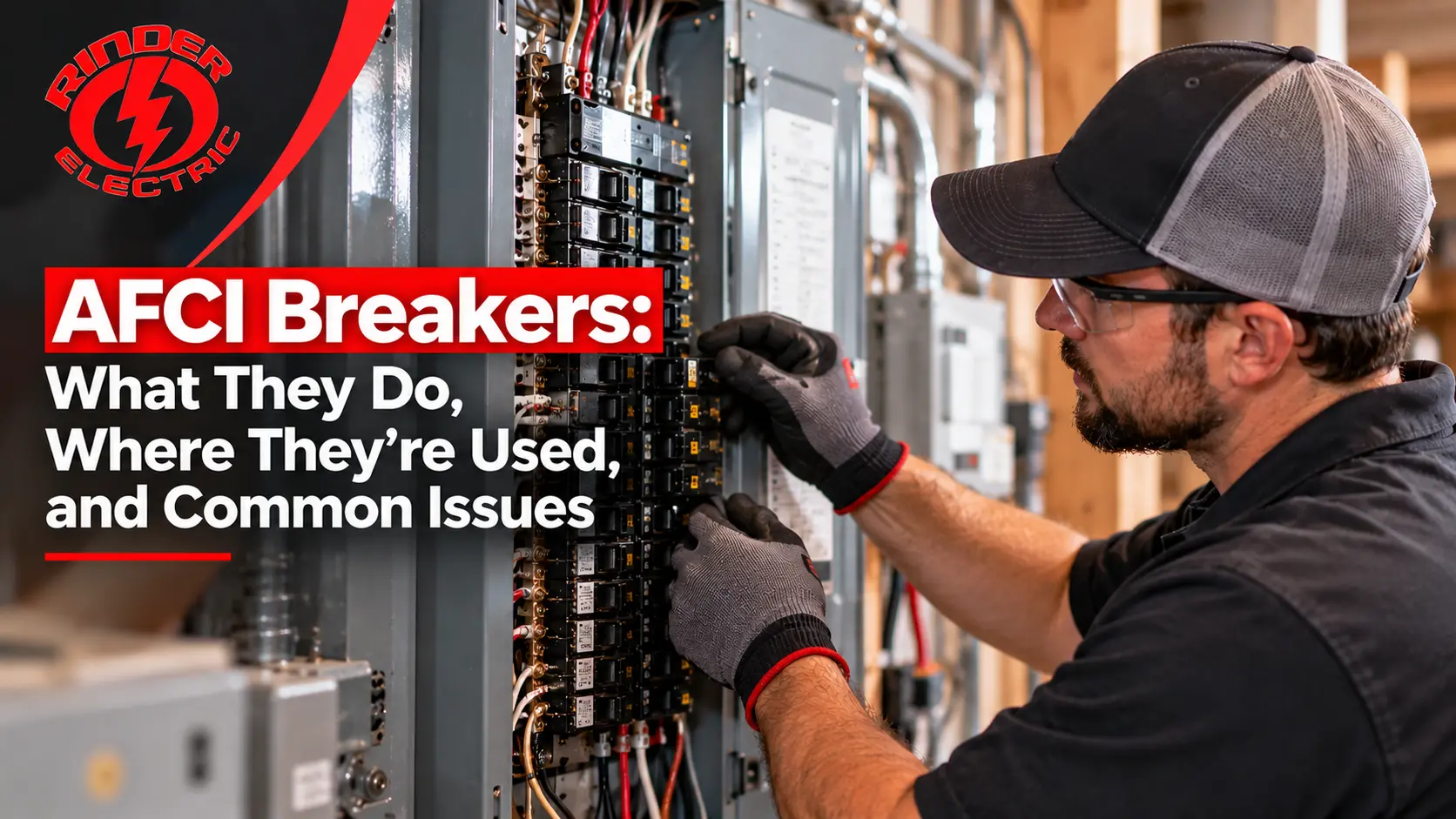
Open your panel door. Look for a breaker with a small test button. That may be an AFCI. The letters stand for arc-fault circuit interrupter. The device cuts power when it detects certain patterns linked to dangerous arcing. It acts before an arc can overheat nearby materials and start a fire.
How an Arc Fault Circuit Interrupter Works
An arc fault is electricity jumping a gap where it should not. Picture a nicked cable inside a wall. Or a loose connection behind a receptacle, the outlet you plug into. Current can leap across the damaged spot in small bursts. Those bursts create intense heat in a tiny area. Often there is no visible warning.
An AFCI breaker watches the electrical signal on its circuit. It is built to tell hazardous arcing apart from normal activity. A motor starting is normal. So is a flipped switch. When the breaker sees a dangerous pattern, it trips. Detection methods vary by manufacturer, so treat this as the general idea.
AFCI Protection vs. Standard Circuit Protection
A standard breaker answers two questions. Is too much current flowing for too long? Is there a short circuit? Those are overload and short-circuit protection. A damaged cable can arc while current stays below the trip point. The standard breaker never notices the problem at all.
AFCI protection adds a different job. It looks at how the current behaves, not just how much there is. It does not replace standard protection. It also cannot promise to catch every fault. No device can stop every fire. Think of it as one more layer.
Where Are AFCI Breakers Used?
The right spot for an AFCI depends on the circuit and the building. It also depends on which electrical code your area enforces. Each state or city picks a code edition. Many also add their own amendments. Always check the local rules before you assume anything.
Common Residential Applications
Recent editions of the National Electrical Code extend AFCI protection to many branch circuits, which carry power from the panel to outlets and lights. Bedrooms are a classic example of areas requiring this protection. Living rooms, hallways, and closets may also be covered. Although national codes have expanded AFCI requirements to kitchens and laundry areas, Indiana state rules limit mandatory AFCI protection mainly to bedrooms and living spaces.
When AFCI Installation May Be Needed
AFCI installation often comes up when someone pulls a permit. New construction is the clearest case. Builders install the protection the adopted code calls for on covered circuits. Remodels are murkier. Depending on the code edition, changing or extending a branch circuit can trigger AFCI rules for that circuit.
Requirements vary by jurisdiction and by project. Local amendments can change the picture. Before you plan any work, confirm what applies. Ask a qualified electrician. Or call your local building department. A quick call now can save a failed inspection later. That keeps the project on schedule.
How Do You Test and Reset an AFCI Breaker?
Read the label on your breaker first. Testing and resetting steps come from the manufacturer and differ by model. For the device in your panel, the manufacturer’s instructions win.
How to Test an AFCI Breaker
Most AFCI breakers have a built-in test button. Pressing it simulates a fault. If the protective function works, the breaker trips. That checks the device itself. It does not inspect the wiring on the circuit. It will not find a loose connection hiding behind a wall.
How often you press it depends on the model. Look for instructions on the breaker or in the manufacturer’s documentation. Keep the panel cover on. Keep your hands off the wiring. If the breaker does not trip during the test, call an electrician right away. Do not guess.
How to Reset an AFCI After It Trips
A tripped breaker often rests between ON and OFF. Many models ask you to push the handle fully to OFF first. Then you move it back to ON. Your breaker’s instructions explain what the handle and any indicator mean. Follow those. Do not force the handle.
A reset clears the trip. It does not fix the cause. If the breaker holds and nothing seems wrong, you may have seen a one-time event. If it trips again, stop. Do not keep flipping it until it stays on. Each trip tells you something on that circuit needs a look.
Why Do AFCI Breakers Keep Tripping?
A trip means the breaker sensed something it did not like. Sometimes that is a quirky plug-in device. Sometimes it is a real electrical fault. You cannot tell which by staring at the breaker. The causes below are possibilities. They are not conclusions. Only an inspection can confirm the cause.
Damaged Wiring or Electrical Connections
Wiring trouble is exactly what an AFCI exists to catch. Insulation can crack with age. A nail can pierce it during a renovation. Terminals can work loose over the years. Any of these can create the arcing the breaker is built to detect. Repeated trips may follow. Leave the hunt to an electrician.
Appliances, Devices, and Nuisance Tripping
Plug-in equipment can set off a breaker too. Some power tools and older motors produce electrical noise that looks like an arc. So can certain dimmers. A worn cord on a lamp or heater can create real arcing right at the device. That one is no nuisance.
Electricians call a trip without a clear hazard nuisance tripping. Do not assume the breaker is just too sensitive. A trip that seems harmless may point to a real problem. Note what was running when it tripped. Tell your electrician. Stop using any device with a damaged cord.
Wiring Errors or a Faulty Breaker
A shared neutral between circuits can trigger repeated trips. The neutral is the return path for current. A loose terminal at the breaker can do the same. Compatibility matters too. Some breakers are designed for specific panels. Mismatched parts may misbehave. Only a check of the installation will show it.
The breaker itself can be defective. A symptom alone does not prove it. A breaker that keeps tripping looks the same whether the fault sits in the breaker or elsewhere on the circuit. Replacing it without a diagnosis can leave the real problem in place.
When Should You Call an Electrician for AFCI Troubleshooting?
One trip after a storm or a busy evening is not an emergency. Still, it is worth noting the date and what was running. If the same breaker trips again within days, treat it as a repair job. Call a professional if you see any of these signs:
- The breaker trips again and again, even with the likely culprit unplugged
- The breaker will not reset
- Part of the home loses power for no clear reason
- Outlets or cover plates look scorched or discolored
- A receptacle feels unusually warm
An electrician can inspect the affected circuit. They can check what is plugged in. They can confirm the breaker is installed correctly and suits the panel. That sorting step matters. Each cause needs a different fix. A blind guess can waste money and miss the real hazard.
| Safety warning: Do not bypass AFCI protection. Do not open the panel to look at live parts. Do not keep resetting a breaker that trips again. If you see smoke or active sparking or smell something burning, move away and call 911. |
Frequently Asked Questions
Do AFCI Breakers Prevent Electrical Fires?
They can help reduce the risk. They cannot prevent every fire. An AFCI breaker is built to detect certain hazardous arcing conditions and shut off power. Fires also start from overloaded circuits and faulty equipment. Those causes fall outside what this device targets. Smoke alarms and safe habits still matter.
How Often Should an AFCI Breaker Be Tested?
Follow the manufacturer’s instructions for your model. Schedules and procedures differ between brands. No single interval fits every breaker. If the label is unclear, an electrician can identify your model. They can also tell you what the maker recommends. Keep the manufacturer’s paperwork somewhere easy to find.
Should an AFCI Breaker Be Replaced if It Keeps Tripping?
Not automatically. Repeated tripping points to a cause nobody has found yet. The breaker is only one candidate. The real source may be the wiring. It may be a connected device. It could even be an installation error. Diagnosis shows which fix fits. Sometimes that means a wiring repair. Sometimes it means a new breaker.
Final Thoughts
Arc fault protection earns its place in the panel. It watches for a hazard that standard breakers can miss. Knowing what the breaker does helps you read what your panel is telling you. Code requirements and testing steps still vary by location and by breaker model. Check before you act.
Rinder Electric is a licensed, bonded, and insured electrical contractor. The team serves Indianapolis and Central Indiana. Does your AFCI breaker keep tripping or refuse to reset? Are you concerned about what might be causing the problem? A qualified assessment can help identify what is happening on the circuit. To discuss an AFCI problem or other electrical needs with Rinder Electric, call the team for more information.