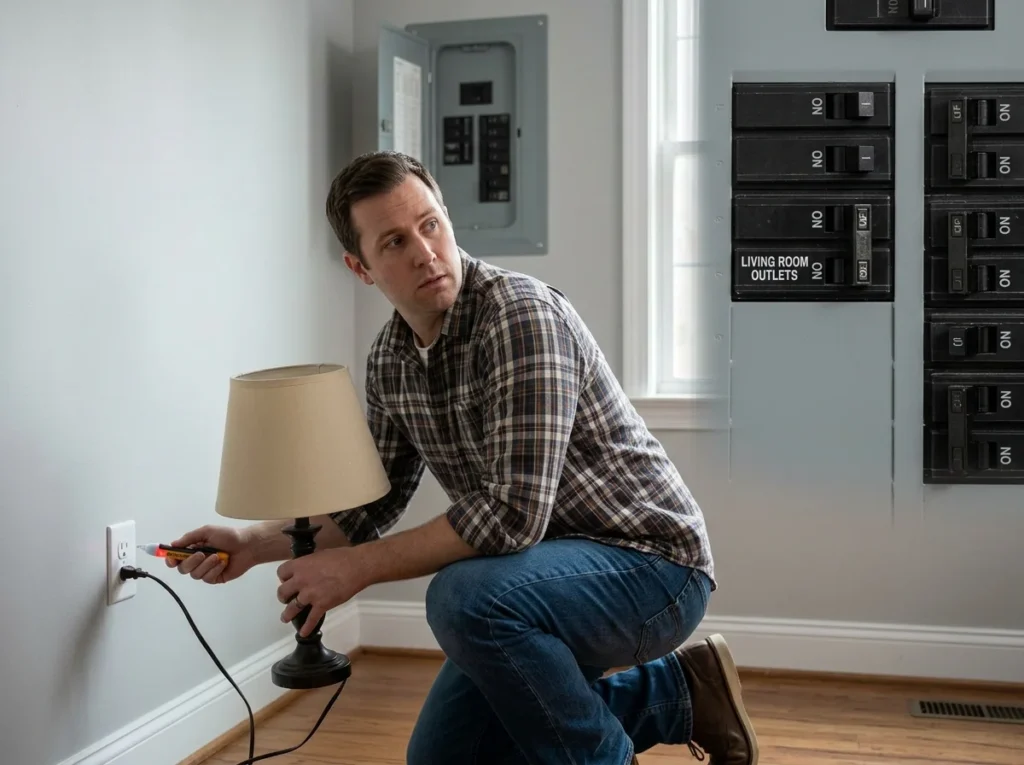
You plug in a lamp, but it stays dark. Then you try your phone charger in the same outlet, and it doesn’t work either. So you head to the electrical panel, and every breaker looks like it’s on. It’s a confusing spot, and it’s one of the most common reasons homeowners end up searching for electrical outlets not working.
A breaker that looks normal doesn’t prove power is reaching the receptacle. The cause could be a tripped GFCI or other protective device, a failed outlet, a loose connection, or a break somewhere in the circuit’s wiring. If you have a power outlet not working in your Indianapolis home, here’s how to sort through the possibilities safely.
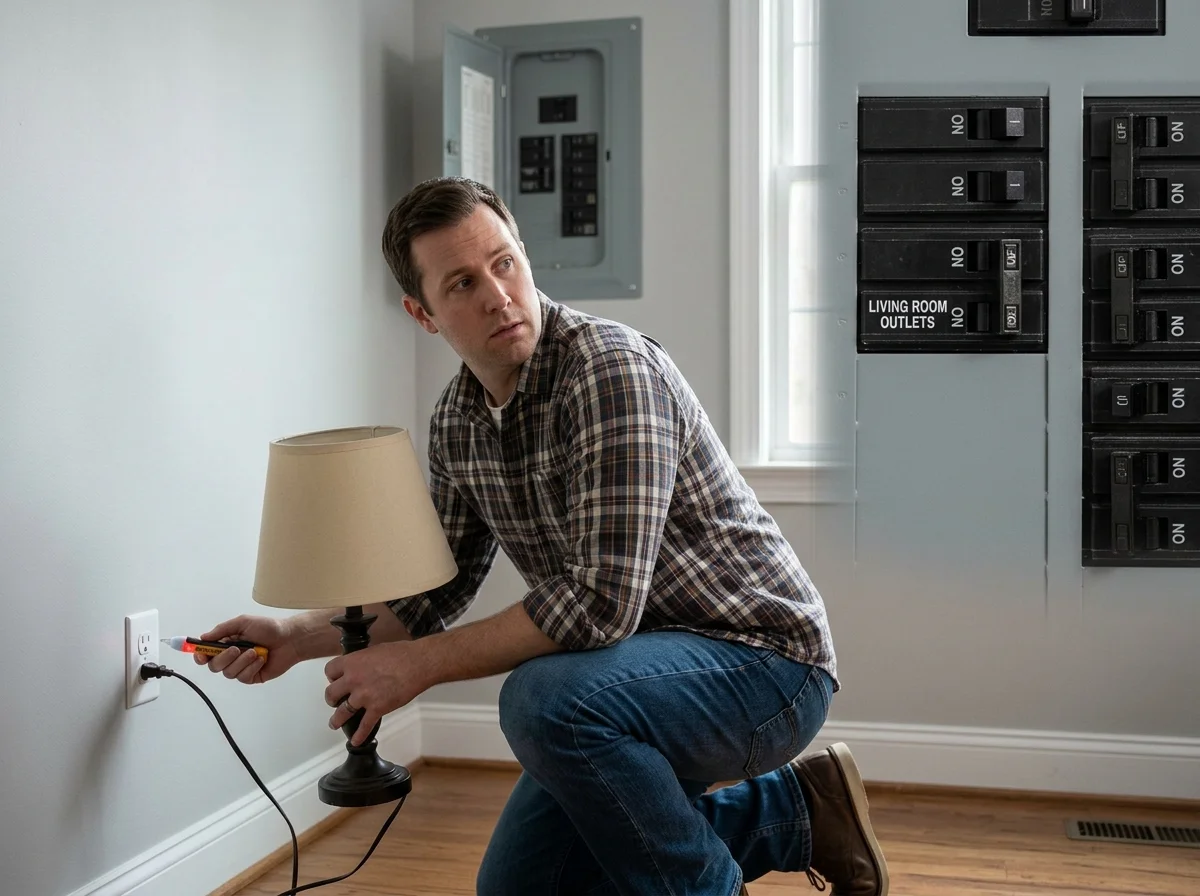
A Breaker Being On Does Not Guarantee Power at the Outlet
Your breaker only trips when something forces it to, and that something is too much current. Overload the circuit or let a hot wire touch a neutral, and it shuts off. The breaker has no way to know whether the outlet itself has failed. If a wire pulls loose behind the receptacle or a splice fails somewhere inside the wall, the circuit is just open. No current flows, there’s nothing for the breaker to react to, and the handle stays in the on position.
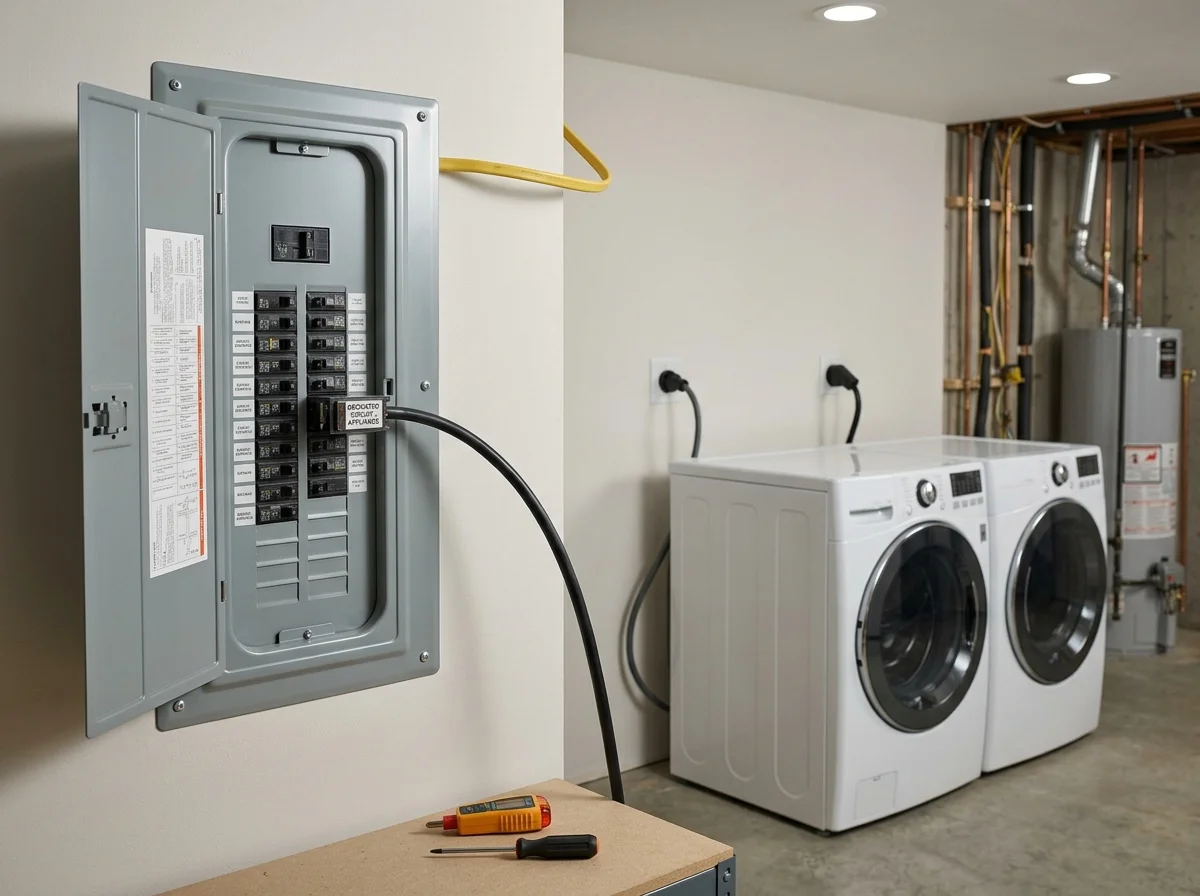
That leaves you with a dead outlet even though everything at the electrical panel looks normal. The breaker sits at one end of the branch circuit, and your dead electrical outlet could be at the other end, with a lot of wire and a few connections in between. Any one of those can quit without the breaker ever finding out. If broader electrical capacity or panel problems are suspected, an electrical panel replacement in Indianapolis may need to be considered after proper evaluation.
Start With the Checks That Do Not Require Opening the Outlet
A few quick checks can rule things out without touching anything inside the wall.
Test the Device Somewhere Else
Lamps burn out, chargers fail, and cords wear through. Try that same device in another outlet that you know is working. If it’s dead there too, the device was the problem, and the outlet may be fine.
Check Nearby Outlets
Test the outlets around the dead one, including any in adjoining rooms, since one circuit often serves more than one space. One outlet not working usually points to something local. If multiple outlets stopped working together, a bigger piece of the circuit is affected.
Look for a GFCI Receptacle
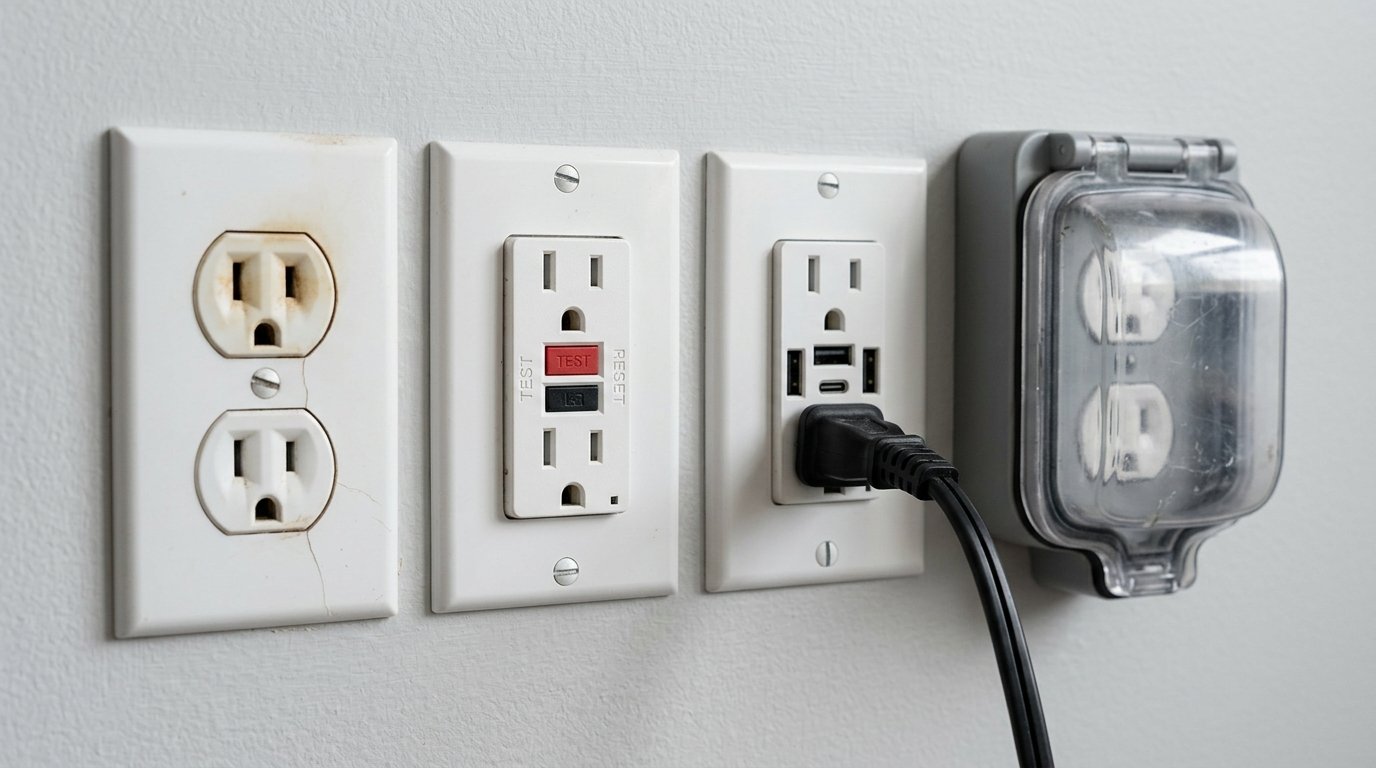
GFCI protection can cut power to other outlets wired downstream from it, and the GFCI doesn’t have to sit next to the dead outlet. Check the bathroom, kitchen, garage, basement, laundry area, and exterior outlets. A tripped GFCI often shows a reset button that’s popped out or an indicator light that has changed. If you find one, press the reset button firmly and see whether power returns. Leave every cover plate and receptacle in place while you look.
The Number of Dead Outlets Gives You a Useful Clue
How many outlets lost power, and where they are, helps narrow down the cause. It doesn’t identify it. Only testing the circuit can show where power actually stops, so treat this table as a starting point, not a diagnosis.
| What you notice | What it may suggest | Next step |
| One outlet is dead | Receptacle or local connection issue | Check the safe basics, then arrange troubleshooting if it stays dead |
| Several nearby outlets are dead | GFCI, upstream connection, or circuit interruption | Check relevant GFCIs and seek professional testing if power does not return |
| Outlets in different areas are dead | Shared circuit or broader electrical issue | Stop guessing and have the circuit investigated |
| Outlet works intermittently | Failing receptacle or connection | Stop relying on it and arrange an inspection |
| The outlet went dead after another electrical event | Protective device or circuit problem | Check the appropriate protection, then seek troubleshooting if unresolved |
None of these patterns is definitive. Two homes can show the same symptoms and have completely different faults.
What Happens When the Electrical Path Is Interrupted?
Most dead outlets come down to a break in the path that power follows. Here’s how that break can happen at three different points.
A Loose Connection May Break the Power Path
An outlet connects to the circuit wiring at wire terminals, either under screws or in push-in openings. If a wire works loose or never makes solid contact, the electrical path can be interrupted right there. The receptacle goes dead even though the wiring feeding it may still be energized, and the breaker stays on. A loose connection at one outlet can also leave other outlets farther along the circuit without power.
A Failed Receptacle May Stop Supplying Power
Inside a duplex receptacle, metal contacts carry power to whatever you plug in. Worn contacts, a cracked body, or a failed internal part can stop that flow. A damaged electrical receptacle can look fine from the outside, and a worn-out electrical outlet may grip plugs loosely or not make contact at all.
The Fault May Be Before the Outlet
The outlet that has lost power isn’t necessarily where the fault started. A failed connection or damaged wiring upstream can cut off everything beyond it. That’s one form of branch circuit failure, and it’s why electrical wiring problems can show up as outlets that seem unrelated to each other.
GFCI and AFCI Protection Need a Different Approach
Some circuits have built-in protection that can shut power off on its own, and each type resets a little differently.
A GFCI May Interrupt Power Downstream
A GFCI shuts off power when it detects a ground fault, and outlets wired downstream from it lose power along with it. Pressing the reset button is the normal first step. If it won’t stay reset or trips again soon after, something is making it disconnect, and repeated resetting won’t fix that.
AFCI Protection May Also Disconnect a Circuit
Some circuits use AFCI protection, often built into the breaker itself. After an AFCI trips, you may need to move the handle all the way to the off position before switching it back on. A dead outlet doesn’t automatically mean the AFCI is the problem, though. But a protective device that keeps disconnecting points to an underlying issue. Frequent circuit breaker problems like that call for an electrician, not more resets.
When Troubleshooting Should Stop
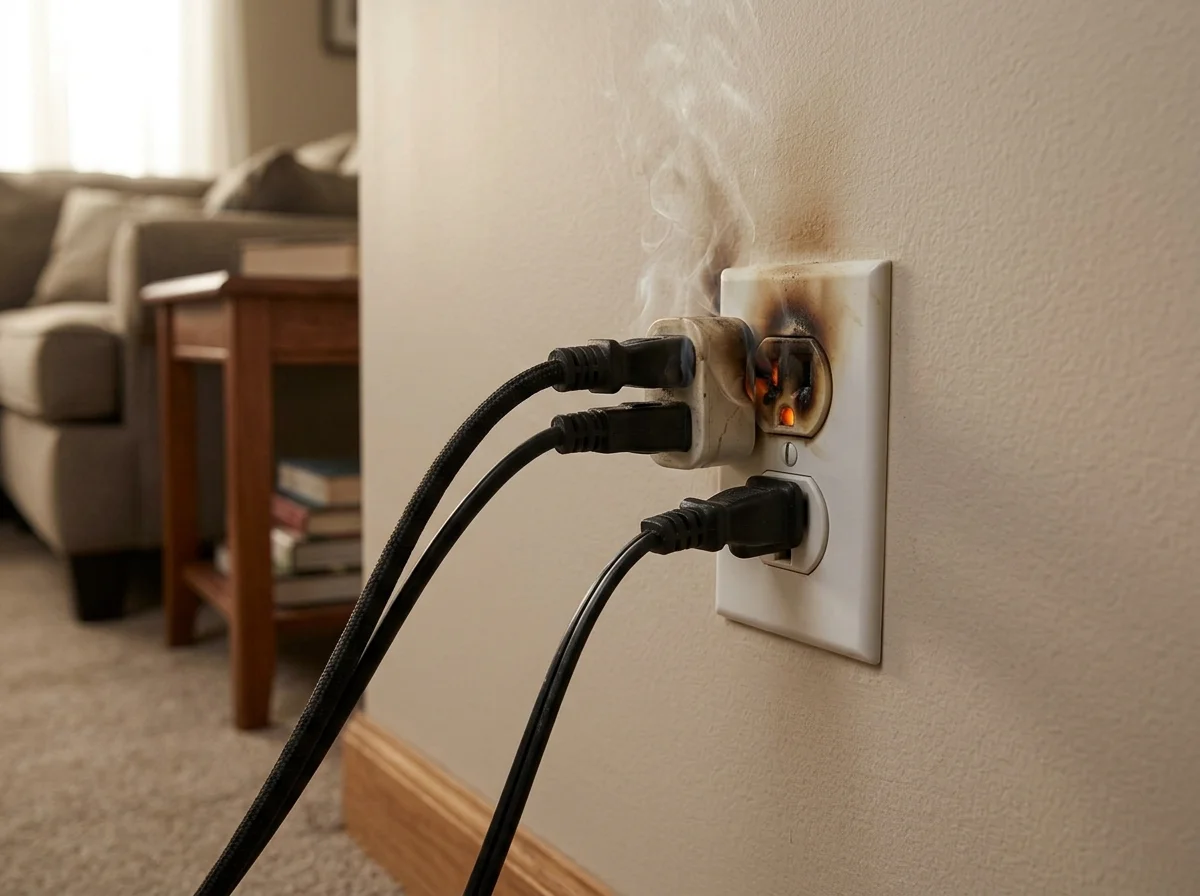
Checking the device, the neighboring outlets, and the GFCIs is as far as most homeowners should go. Stop and call an electrician if you notice any of these:
- exposed wiring
- a burning odor
- visible damage to the outlet or cover plate
- sparking
- buzzing or crackling
- heat around the receptacle
- a protective device that keeps tripping
- any doubt about whether the circuit is energized
That last one deserves real weight. If you can’t tell whether a circuit is live, treat it as live.
| Safety Warning: A dead outlet does not prove that every conductor inside the electrical box is safe to touch. Wires in the box may still be energized, sometimes from a different circuit. Don’t remove the receptacle or handle exposed wiring just because the outlet has no power. |
What an Electrician Checks When an Outlet Has No Power
Electrical outlet troubleshooting is really about finding where the power stops. An electrician doesn’t have to begin by swapping the outlet you can see. Depending on what the circuit shows, the work may involve measuring voltage at the dead receptacle and at other points along the circuit, checking GFCI protection and other protective devices, testing continuity, inspecting wire terminals and connections, looking at the condition of the receptacle, and tracing the branch-circuit wiring.
Not every job needs every step. A dead outlet with an obviously failed receptacle may be quick. One that traces back to a damaged connection farther along the circuit takes more work.
Once the break is located, the repair follows from what’s found, whether that’s a replacement receptacle, a remade connection, or outlet wiring repair upstream. Rinder Electric handles electrical troubleshooting in Indianapolis and Central Indiana, including dead outlet repair and circuit repair when the problem goes deeper than one receptacle.
When an Outlet Replacement Is the Actual Fix
Sometimes the receptacle really is the problem. If testing shows power reaching the receptacle but not getting to the plug slots, or the outlet has damaged contacts or a cracked body, electrical outlet replacement is a straightforward repair.
It isn’t always that simple. If the fault sits in a connection, a GFCI, the circuit, or a break upstream, a new outlet at the dead location may do nothing or work for a while and fail again. A faulty electrical outlet and a faulty circuit can look the same from the wall.
Replacing the visible outlet without finding out why power was lost isn’t always a complete repair. That’s why residential electrical repair in Indianapolis should start with finding the cause.
How Much Does Electrical Outlet Repair Cost in Indianapolis?
Most electrical outlet repairs in Indianapolis run between $150 and $500, depending on what the troubleshooting turns up. A few numbers help set expectations.
Most electricians charge a service call or diagnostic fee of about $75 to $150, and many credit it toward the repair when the work is done in the same visit. Replacing a standard receptacle typically costs about $100 to $350, and a GFCI outlet usually lands around $175 to $350. Hourly labor for a licensed residential electrician in the Indianapolis area commonly runs $85 to $150.
Wiring is a different story. Tightening or remaking a loose connection can be a short job, but replacing damaged wiring is often priced by the length of wire involved, with one national estimate at roughly $10 to $15 per linear foot. A circuit fault that takes time to trace can cost more than a simple outlet swap.
These are ballpark figures for 2026, not a quote. Two dead outlets that look identical can carry very different bills, which is why it pays to have the fault identified before you compare estimates for electrical outlet repair in Indianapolis.
FAQs About Electrical Outlets That Stop Working
What could leave an outlet without power while the breaker stays on?
A breaker doesn’t trip for every electrical problem.The cause may be a GFCI that has tripped, a failed receptacle, a loose wire connection, damaged circuit wiring, or a fault somewhere else along the circuit.
What should I do if an outlet suddenly stops working?
Test the device at another outlet, then check the outlets nearby. Look for a tripped GFCI in the bathroom, kitchen, garage, basement, laundry area, or outside, and press its reset button if you find one. Don’t open the receptacle. If power doesn’t return, call an electrician.
Can one GFCI outlet cause other outlets to lose power?
Yes. Outlets wired downstream from a GFCI get their protection through it. When it trips, they lose power too, and the GFCI may be in a different room.
Can a faulty outlet cause a loss of power?
Yes. A damaged receptacle or loose connection can stop power from reaching the outlet. If other outlets are connected farther along the same circuit, they may lose power as well.
What causes an electrical outlet to lose power?
Common causes include a tripped GFCI, a failed receptacle, a loose wire connection, damaged wiring, an upstream break in the circuit, and a protective device that has disconnected the circuit.
When should I call an electrician for an outlet that has no power?
Call if the basic checks don’t restore power, if several outlets are affected, if the problem keeps coming back, or if a GFCI or breaker keeps tripping. Call right away for wiring concerns or warning signs like a burning odor or sparking.
Final Thoughts
A breaker that looks normal doesn’t mean an outlet is getting power, and the number and location of dead outlets can help point you in the right direction. If the basic checks don’t bring power back, Rinder Electric can help with electrical troubleshooting, outlet repair, and circuit repair across Indianapolis and Central Indiana. Give us a call at (317) 701-1713 to schedule a service visit or get an estimate.